







On April 28, 2025, 50 million people across Spain and Portugal lost power. Within minutes, mobile networks started failing. WhatsApp stopped working. You couldn't call 112. You couldn't pay in shops. Traffic lights went dark. Trains stopped. And for roughly 18 hours, entire countries were cut off from the communication systems we all take for granted.
It was the largest blackout in Europe in over 20 years. And it revealed something most people don't think about: when the power grid goes down, your phone becomes useless.
Not because your phone battery is dead — but because the cell towers that carry your signal run on grid electricity. Most towers have backup batteries that last 2–8 hours. After that, they go silent. No calls, no texts, no internet, no WhatsApp, no maps. Nothing.
This article explains why that happens, what alternatives exist, and why a small LoRa mesh radio might be the most practical emergency communication tool you can own.
Why Your Phone Stops Working During a Blackout
Your smartphone doesn't connect directly to the internet. It connects to a nearby cell tower, which connects to a fibre backbone, which connects to a data centre — all of which need continuous electricity to function.
When the power goes out:
- Hours 0–2: Most cell towers switch to backup batteries. Service continues normally, but the clock is ticking.
- Hours 2–4: Towers in areas without robust backup start dropping off. Coverage becomes patchy. Calls may still connect, but data slows or stops.
- Hours 4–8: The majority of towers run out of backup power. In rural areas, this happens faster. In cities, some critical towers may have generators — but not all.
- Hours 8+: Most mobile communication is effectively gone. Only towers with dedicated diesel generators or direct fibre connections remain operational.
This isn't theoretical. During the Spain/Portugal blackout, Dutch research institute NIPV documented that mobile networks failed within hours, emergency services struggled to coordinate, and millions of people had no way to communicate with family, neighbours, or authorities.
The Netherlands' own safety experts are now studying what would happen if a similar blackout hit the Netherlands — and their preliminary conclusion is sobering: we are not prepared.
What About Landlines, Satellite, or Radio?
People often assume there are alternatives. Let's look at each:
Landline phones: Modern "landlines" in the Netherlands run over fibre or VoIP — they need electricity and a working internet connection. The copper telephone network that worked during power outages has been largely decommissioned. Your KPN "landline" is actually internet-based and will fail alongside your router.
Satellite phones: They work, but cost €800–€1,500 per device plus €30–€100/month in subscription fees. Calls cost €1–€5 per minute. Not practical for families or community use.
FM/AM radio: Great for receiving emergency broadcasts (and you should have a battery-powered radio), but it's one-way. You can listen, but you can't communicate back or coordinate with others.
PMR446 walkie-talkies: Cheap and useful for short range (1–3 km in practice), but limited to voice only, no encryption, and no way to relay messages beyond direct range. They also can't share GPS positions or text messages.
Amateur (ham) radio: Very capable, but requires a licence, technical knowledge, and expensive equipment. Not accessible for most people.
There's a gap here: something affordable, licence-free, easy to use, that works without any infrastructure, can send text messages and GPS positions, and can relay messages over long distances. That's exactly what LoRa mesh fills.
How LoRa Mesh Communication Works
LoRa (Long Range) is a radio technology designed for sending small amounts of data over very long distances using very little power. Meshtastic is free, open-source software that turns inexpensive LoRa radio devices into a mesh communication network.
Here's how it works in practice:
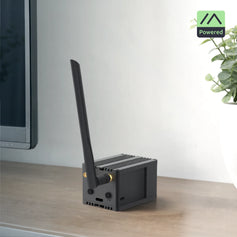
Each device is a radio. A Meshtastic device (like the WisMesh Pocket V2) contains a LoRa radio that communicates directly with other Meshtastic devices — no cell tower, no internet, no infrastructure of any kind needed.
Messages hop through the mesh. If you're out of direct range from someone, your message automatically gets relayed through other Meshtastic devices between you. Each hop extends the range. With a few well-placed devices, you can cover an entire neighbourhood or village.
It runs on battery and solar. LoRa devices consume very little power. A WisMesh Pocket V2 lasts for days on a single charge. A WisMesh Repeater Mini runs indefinitely on its built-in solar panel — no grid power needed, ever.
It's completely licence-free. LoRa operates on the EU868 frequency band (863–870 MHz), which is licence-free across Europe under ETSI regulations. No amateur radio licence, no registration, no subscription. Buy it, turn it on, use it.
It sends text and GPS. You can send text messages (like SMS), share your GPS position in real time, and receive positions from others in your mesh — all displayed on a map in the free Meshtastic app on your phone (connected via Bluetooth, which works without cell service).
What This Looks Like in Practice
Imagine a neighbourhood during a power outage that lasts more than 4 hours:
Without mesh: No one can call or text. People walk to neighbours' houses to check if they're okay. Parents can't reach children at school. The elderly are isolated. No one knows what's happening or when power will return. Rumours spread. Panic grows.
With a simple mesh network: Five households in the neighbourhood each have a Meshtastic device. They can text each other instantly. Someone with a battery-powered FM radio hears an update from the emergency broadcast and shares it with the mesh. A family confirms their elderly parents are safe. The school sends a message that children can be picked up. Everyone knows what's happening. Coordination replaces chaos.
Now scale that up. Add a solar-powered repeater on the roof of a community centre or church tower, equipped with a 6 dBi outdoor antenna. Suddenly your mesh covers the entire town. Messages relay automatically. GPS positions let you find people. And none of it requires a single watt from the grid.
LoRa Mesh vs Other Emergency Options
| LoRa Mesh (Meshtastic) | PMR446 Walkie-Talkie | Satellite Phone | Mobile Phone | |
|---|---|---|---|---|
| Works without grid power | Yes (battery + solar) | Yes (battery) | Yes (battery) | No (needs cell towers) |
| Text messaging | Yes | No (voice only) | Yes (expensive) | No (without network) |
| GPS position sharing | Yes (automatic) | No | Limited | No (without network) |
| Message relay / range extension | Yes (automatic mesh hopping) | No (direct only) | N/A (satellite) | No |
| Encryption | AES-256 | No | Yes | Yes (when working) |
| Range (practical) | 2–20+ km (with repeaters) | 1–3 km | Global | 0 km (without towers) |
| Licence required | No | No | No | No |
| Monthly cost | €0 | €0 | €30–100/month | €10–50/month |
| Device cost | €28–€107 | €20–€60 | €800–€1,500 | €200–€1,000 |
What Do You Need to Get Started?
A basic emergency mesh setup for a household or small group requires surprisingly little:
Minimal setup (2 people)
Two WisMesh Pocket V2 devices (€99 each). Turn them on, pair with the free Meshtastic app on your phones, and you can communicate over several kilometres — more with line of sight. Keep them charged, and they're ready when you need them.
Neighbourhood setup (5+ people)
Add a WisMesh Repeater Mini (€107) with a tuned EU868 antenna (€9.95) on the highest point in your area — a rooftop, chimney, or church tower. Note: the Repeater Mini uses an RP-SMA antenna port, so you'll need an N-Female to SMA-RP-Male adapter (€9.98) to connect the tuned antenna — also available at Hexaspot. This solar-powered repeater extends coverage across the neighbourhood without needing grid power. Everyone with a Meshtastic device within range is now connected.
Community / village setup
Multiple repeaters with high-gain outdoor antennas placed on elevated points across your area. A 6 dBi antenna on a rooftop can cover 5–15 km of flat terrain. Three well-placed repeaters can blanket an entire small municipality. All solar-powered, all autonomous.
What LoRa Mesh Cannot Do
To be clear about limitations:
- No voice calls. Meshtastic is text and GPS only. The LoRa protocol doesn't have enough bandwidth for voice.
- No internet access. You can't browse the web or use WhatsApp through a mesh network.
- No photos or video. LoRa is designed for small data — text messages and coordinates. Not multimedia.
- Range depends on terrain. In dense urban areas with tall buildings, range is shorter (hundreds of metres to a few km). In flat, open terrain (like the Netherlands), range can exceed 20 km with a good antenna.
- It's not instant. Messages can take a few seconds to propagate through multiple hops. It's fast enough for emergencies, but it's not WhatsApp-speed.
For emergency communication — knowing your family is safe, coordinating with neighbours, sharing critical updates — these limitations don't matter. Text and GPS are exactly what you need when everything else goes dark.
The Netherlands: Flat Terrain, Perfect for LoRa
Here's the good news if you're in the Netherlands, Belgium, or northern Germany: flat terrain is ideal for LoRa. Radio signals travel further when there are fewer obstacles. The Dutch polder landscape, with its open fields and minimal elevation changes, is one of the best environments in Europe for long-range LoRa communication.
A WisMesh Repeater Mini with a 9 dBi tuned antenna mounted on a rooftop in a flat area can realistically cover 15–25 km in every direction. A few of these placed across a municipality, and you have a resilient communication backbone that runs on sunlight.
There's also a growing community building exactly this. Across the Netherlands, hundreds of LoRa mesh repeaters have already been deployed by enthusiasts and local groups — both on Meshtastic and MeshCore firmware. Joining an existing mesh is as simple as buying a device and turning it on.
Emergency Preparedness Checklist
The Dutch government recommends that every household is prepared for at least 72 hours without power and normal services. Here's what a communication-ready emergency kit looks like:
- Battery-powered FM radio — for receiving emergency broadcasts from the government
- Meshtastic device (e.g. WisMesh Pocket V2) — for two-way communication with family, neighbours, and community
- USB power bank (10,000+ mAh) — to charge your Meshtastic device and phone for several days
- Printed contact info and meeting points — because you won't be able to look anything up online
- Meshtastic app pre-installed on your phone, with the device already paired and configured. Don't wait until the emergency to figure out how it works.
The whole point of emergency communication is that it's ready before you need it. A Meshtastic device in a drawer, charged and configured, costs nothing to maintain and could be invaluable when the grid goes dark.
Get Prepared
Every Meshtastic device we sell at Hexaspot ships pre-configured for EU868 and ready to use. No technical knowledge required — pair it with your phone, and you have emergency communication that doesn't depend on cell towers, internet, or electricity.
WisMesh Pocket V2 (€99) — Ready-to-use handheld with GPS, display, and multi-day battery life. Keep one in your emergency kit.
WisMesh Repeater Mini (€107) — Solar-powered relay for extending coverage. Mount it on your roof and it runs forever.
WisBlock Starter Kit (from €27.99) — The most affordable entry point. Add a battery and you have a working emergency radio.
Browse all Meshtastic devices at Hexaspot →
Questions about which setup is right for your household, neighbourhood group, or organisation? Contact us at support@hexaspot.com or call +31 (0)85 200 6150.
Hexaspot is an authorised RAKwireless dealer based in the Netherlands. We ship across the EU and Norway with same-day dispatch on weekday orders before 14:00. All devices operate on the EU868 frequency band — licence-free and legal across Europe.
Last updated: March 2026.


