



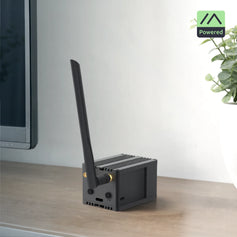




The original WisMesh Repeater Mini earned its reputation the boring way: bolt it up, let the sun do the rest, forget about it. RAKwireless's second-generation version keeps that same formula but adds something the first one never offered, choice. Here's exactly what changed between the original Repeater Mini and the new V2, and which configuration actually fits your setup.
What stayed the same
Both generations share the same core idea and most of the same hardware. A RAK4631 core (Nordic nRF52840 + Semtech SX1262), pre-flashed with Meshtastic and MeshCore-compatible, sits inside an IP67-rated Unify enclosure with an integrated solar panel and a 3200 mAh Li-Ion battery. Both ship in the same 150 × 100 × 50 mm housing, connect through an RP-SMA antenna port, and include a WisMesh Blade antenna in the box. If you already own a V1 and it's working fine on your roof, nothing here forces an upgrade, the fundamentals haven't changed.
What's new in V2
A choice of three configurations, not one. V1 shipped as a single SKU. V2 splits into Standard Power without GPS, Standard Power with GPS, and a High Power 1W variant without GPS, so you're buying the repeater that matches your site instead of the only one available.
A genuine high-power option. The original topped out at 22 dBm. The new 30 dBm / 1W configuration roughly quadruples transmit power, which meaningfully extends range and improves penetration through terrain and obstacles, where local regulations permit that output level. It's worth noting this variant runs on different hardware under the hood (a RAK3401 nRF52 BLE core paired with the RAK13302 1W LoRa module) rather than the standard RAK4631, since driving that much more power needs a different radio stage.
Optional GPS. The GPS configuration adds a RAK12501 GNSS module so the repeater reports its own precise location on the mesh, useful if you're managing several fixed nodes across a wider area and want to keep track of exactly where each one ended up, or map coverage as you expand.
Two durability fixes aimed squarely at outdoor failure points. The battery is now held with upgraded 3M VHB adhesive instead of the original mounting, so it stays put through heat cycling and vibration over years outdoors. And the Type-C charging port now uses a dedicated waterproof connector in place of the original rubber seal, a small change, but ports are exactly where IP67 enclosures tend to fail first after prolonged weather exposure.
Price comparison
|
WisMesh Repeater Mini (V1) |
V2 — Standard, no GPS |
V2 — Standard, GPS |
V2 — High Power (1W) |
|
|
Price |
€107,00 |
€99,95 |
€109,95 |
€109,95 |
|
Core |
RAK4631 (nRF52840 + SX1262) |
RAK4631 |
RAK4631 + RAK12501 GNSS |
RAK3401 + RAK13302 (1W) |
|
Max TX power |
22 dBm |
22 dBm |
22 dBm |
30 dBm / 1W |
|
GPS |
No |
No |
Yes |
No |
|
Battery mounting |
Original |
Upgraded 3M VHB |
Upgraded 3M VHB |
Upgraded 3M VHB |
|
Charging port |
Rubber seal |
Waterproof Type-C connector |
Waterproof Type-C connector |
Waterproof Type-C connector |
Notably, the base V2 configuration is actually cheaper than the original V1, the durability upgrades came bundled in without a price increase over the entry point.
Which one should you buy?
If you're filling a straightforward coverage gap, a hill between two clusters of nodes, a dead spot behind a building, the V2 Standard without GPS covers it for less than the old V1 cost, with the added durability of the newer build. If you're deploying several fixed repeaters across a region and want to track exactly where each one is installed, the GPS configuration is worth the small premium. And if you're pushing coverage across genuinely difficult terrain, dense forest, deep valleys, long line-of-sight runs, the 1W high-power variant is the one built for that job, provided your local regulations allow that transmit level.
For placement, mounting, and antenna advice once you've picked a unit, our solar-powered outdoor repeater installation guide still applies to both generations, the mounting geometry, solar orientation, and line-of-sight principles haven't changed, only the box itself.


